IEEE Transactions on Circuits and Systems for Video Technology (TCSVT)
Collaborative Model and Data Adaptation at Test Time
Chunyun Zhang , Fujun Yang , Chaoran Cui , Member, IEEE, Shuai Gong , Wenna Wang , Xue Lin,Yonggang Qi , Member, IEEE, and Lei Zhu , Senior Member, IEEE
INTRODUCTION
DEEP learning models have achieved remarkable suc�cess in computer vision, but their performance typicallyhinges on the assumption that training and test data are drawn from the same distribution. In real-world scenarios,this assumption often fails due to domain shifts , result�ing in significant performance degradation. To address thisissue, a range of generalization and adaptation strategies havebeen proposed. For example, domain generalization (DG) aims to learn from source data and generalize to previouslyunseen domains, while domain adaptation (DA) transfers knowledge from a labeled source domain to an unlabeledtarget domain. However, both DG and DA require accessto the original labeled source data, a condition that may beimpractical due to privacy concerns or storage limitations.
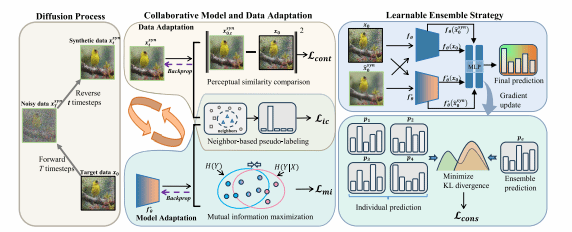
The overall framework of CMDA. CMDA achieves alignment between the target omain data and the source model through the mutual collaboration of model adaptation and data adaptation
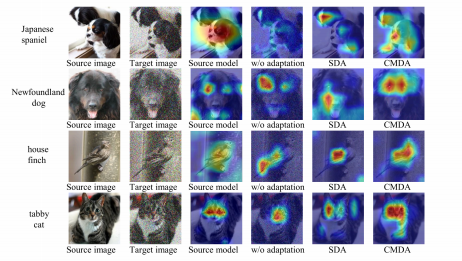
Grad-CAM visualization of feature attention patterns for SDA and CMDA. Highlighted regions (red/yellow) indicate areas that contribute most to themodel’s classification decision