Knowledge-Based Systems
An accuracy-efficiency balanced dehazing method via dual priors and hazecondition classification
Jing Chia,∗, Yanbing Wanga , Bingyi Youa , Shiwei Wub
Introduction
Image dehazing remains a challenging problem in computer visionand image processing. Its primary goal is to restore clear, detail-rich images from those degraded by atmospheric fog or haze, thereby enhancing visual quality and supporting a wide range of computer vision applications [1–6]. Traditional dehazing methods are typically grounded inphysical models, employing atmospheric light scattering principles and the statistical properties of hazy images to estimate and remove haze.These approaches rely on prior assumptions to estimate key parameters,such as the transmission map and atmospheric light. Representative examples include the dark channel prior (DCP) [7], color attenuation prior(CAP) [8], haze-line prior [9], and color-line prior [10]. However, their reliance on fixed priors limits their ability to handle diverse haze andillumination conditions, resulting in reduced generalization and perfor�mance in complex natural scenes.
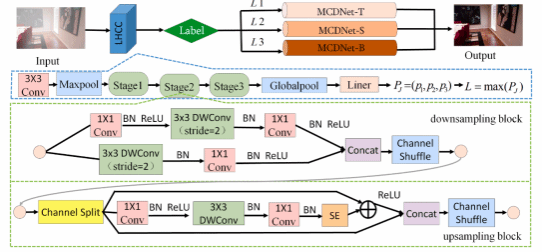
Network architecture of our proposed model
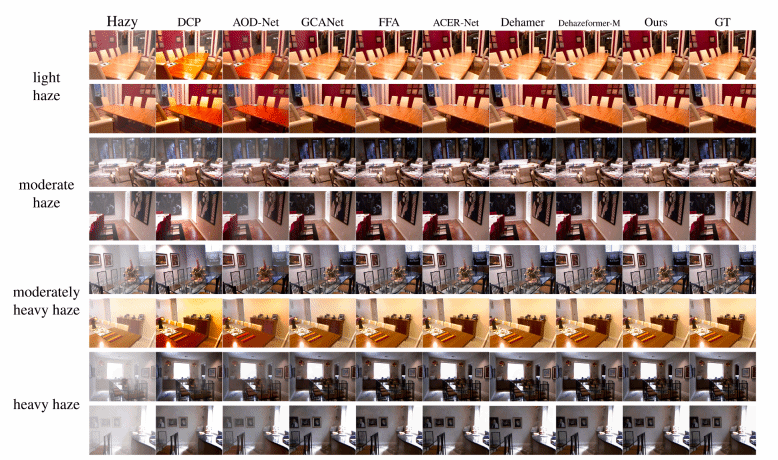
Visual comparison of dehazing results between our extended model and other methods on the SOTS-Indoor test set